

Aaron Renn’s recent essay on civic leadership diagnoses what happened to American cities that stopped growing. He traces the loss of one specific archetype: the locally rooted founder-power-broker. Richard Ravitch in New York. Dan Gilbert in Detroit. George Kaiser in Tulsa. A principal whose personal fortune rose and fell with the city’s, who could land a stadium or a hospital with one phone call. Renn names the cause: corporate consolidation, especially in banking, utilities, and retail. The mechanism is specific. Where there used to be founder-power-brokers, you now have either the regional president of a national corporation, or the professional CEO of a firm that happens to be headquartered locally but earns 95% of its revenue elsewhere. Neither has skin in the city’s outcome.
Minnesota is my adopted home. The local conversation about Renn’s piece these past few weeks has fixated on his non-profit analysis (well intentioned, cohesive, insufficient power to affect growth). The more important discussion to be had is our missing founder-power-broker layer, and the once-in-a-generation opportunity AI gives us to rebuild it this year.
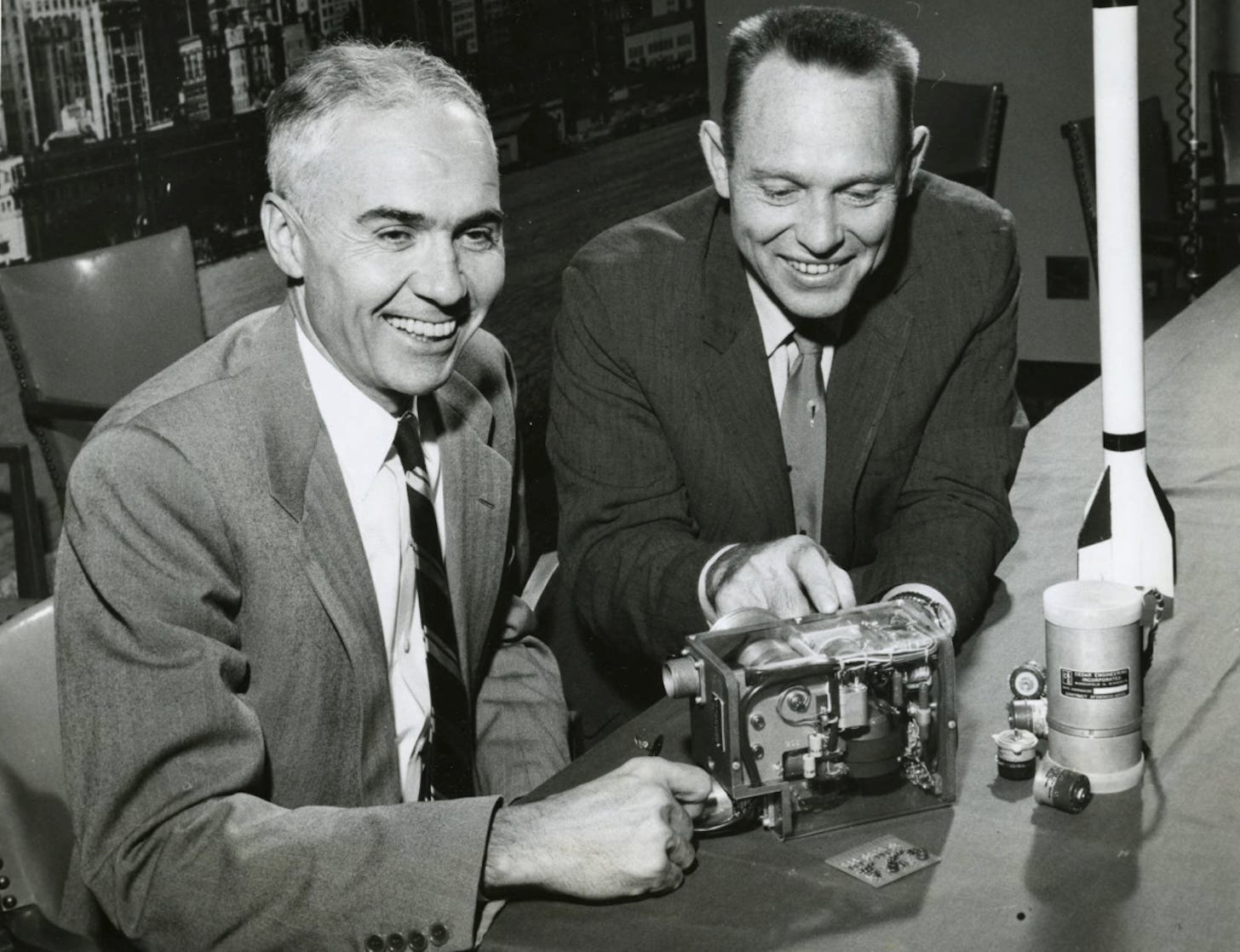
The archetype, in Minnesota, by name
Minnesota’s historical tech industry was built by imports. The founders who turned the region into a national computing and medical device hub between 1946 and 1980 were almost entirely not from here.
John Parker (Massachusetts born, raised in Maine) founded Engineering Research Associates (ERA) in St. Paul in 1946 with a team of Navy codebreakers. ERA built the first commercial computers in the United States and seeded what would become the Twin Cities computing industry. Remington Rand acquired ERA in 1952; the operation became the UNIVAC division.
Bill Norris (Nebraska native) co-founded Control Data Corporation out of UNIVAC in 1957 with Seymour Cray. CDC scaled to 60,000 global employees. The CDC 6600 (1964) and 7600 (1969) were the fastest computers in the world. Norris also organized the Northwest Growth Fund, the Minnesota Seed Capital Fund, the Minnesota Cooperation Office, and Minnesota Wellspring, civic infrastructure that compounded for decades after his retirement. There are 76 distinct companies that traced their lineage back through UNIVAC and ERA. Minneapolis-St. Paul was, briefly, the most important computing region in the country.
Manny Villafaña, the “Puerto Rican kid from the Bronx”, was hired into Medtronic in 1967 as international sales administrator. From Medtronic, he went on to found Cardiac Pacemakers Inc. in 1971 and St. Jude Medical in 1976. Abbott bought St. Jude for $25 billion in 2017. He is on his eighth startup, Medical 21, which filed an S-1 in February. Although no longer based in Minnesota, October 27 is still Manny Villafaña Day here.
Three imports. All of them built here, scaled here, and turned the region into a national tech hub for three decades. Their personal and company fortunes rose and fell together, and they treated Minneapolis-St. Paul’s success as their own.
Minnesota built its computing industry, and the med-tech cluster that would follow, by recruiting founders from other markets.
Why did Minnesota’s first wave end?
The founder-power-broker layer disappeared for a deeper structural reason. Parker, Norris, and Villafaña built ERA/UNIVAC, Control Data, and St. Jude, and turned the region into a national tech hub for three decades. Then, having seemingly arrived, between 1986 and 1995 Minnesota doubled down on building its bench of Fortune 500 headquarters instead of recruiting the next generation of founder-led companies in PCs, mobile phones and the internet.
Marc Andreessen laid out his favorite rule of thumb recently for assessing the vitality and growth prospects of an industry, but I’m going to venture it works just as well to describe a region.
“If the founders of the companies are currently serving as CEO, chairman or chairwoman, or board member of their companies, it’s a good industry to enter. It is probably still young and vital, and there are probably still opportunities to exploit all over the place, either at those companies or at new companies in that industry. If not—if the founders are dead or out of touch—beware. The industry is now being dominated by companies run by second, third, or even fourth generation managers who inherited their companies pre-built, and are serving as caretakers.”
Apply Andreessen’s test to Minnesota’s seventeen Fortune 500 today. Zero are still run by their living founders or have been in the modern era.
Why does Minnesota generate so few founders on its own?
We Minnesotans are familiar with our Kauffman Foundation rate, 0.17 percent, the lowest in the nation (UCLA’s Robert Fairlie, Iowa Startup Collective), to much wringing of hands.
But it’s hardscrabble necessity that forges founders, and good living that makes corporate employees. Natural beauty, top schools and healthcare, solid wages, Fortune 500 careers. The same features that make Minnesota a great place to raise a family also blunt the Maslow pressure that forges founders.
The flip side is that those same conditions make Minnesota eminently recruitable. And recruitment, not cultivation, is the near-term strategy because we don’t have the population to get the founder-business-creation flywheel spinning organically.
A common misconception when Minnesotans speak of recruiting from Silicon Valley or other tech clusters is that we’re looking for the boomerang to return home with their tech skills. That targeting may work with employees, and while that segment is slightly more risk-polled than their contemporaries who stayed local, as noted earlier, founders have a different profile and are more recruitable than the corporate population.
Our target is the top lieutenant, just coming off a Bay Area unicorn. They are not from there either, and are ready to strike out on their own. They want what Minnesota offers: clean lakes, cohesive neighborhoods, a school system their kids can thrive in. And a nascent ecosystem they can help build, rather than be founder number 67 in their mentors’ already dense ecosystem.
What the AI wave actually changes
In 1948, Allied decartelization broke up Germany’s industrial conglomerates. What followed was the Mittelstand: the most durable small-business export economy in modern history, built by founders who could now own outcomes that had previously been locked inside a few dominant firms. The structural opening of decartelization produced a generation of builders.
The AI wave does the same thing to American cities in 2026. It collapses the cost of starting and scaling a company. It will create market openings similar to decartelization on our Fortune 500. At the same time it will put the operating leverage that used to require a Fortune 500 platform into the hands of a small senior team. And it does that across every operationally complex industry at once, which is why it is going to be particularly disruptive to Minnesota’s stock of good paying corporate jobs.
The AI wave will be much broader, more niched, and much less dependent on VC drop bys (or capital) or engineering talent wanting to live in specific SF zip codes.
Anduril, for example, built a $60 billion enterprise value out of Costa Mesa, having explicitly chosen to stay out of Silicon Valley.
We’re going to witness a cambrian explosion in new business creation and this next wave of founders can build wherever they want. AI-native founders don’t need permission from their cap table, a regional consortium, or development office. They just need a welcoming place to build.
The lieutenant we just described has the playbook, the network, and is now spinning up three to five companies on AI-native rails, in parallel, in the same way their mentors used to run one scaleup at a time.
We have to choose to compete in the battle for AI founder talent. The AI wave is a once-in-a-generation opportunity to restart Minnesota’s growth engine. Actively recruiting founders is how we rebuild it.
We all need to pitch in
The work is recruitment. Selling the ecosystem building opportunity in Minnesota is the motion. Every actor below has a lever that serves the same goal: the short term growth and long term viability of our home State. If you are on this list and you are not actively recruiting, you won’t be able to say you did everything you could to not let this wave pass Minnesota by.
Governor Walz can sign a founder-migration executive order this quarter: a state-funded performance-based forgivable loan for relocating AI-native founders, benchmarked against three-year employment and revenue milestones, modeled on Utah’s EDTIF and North Carolina’s JDIG. He can also commit Minnesota to being the leading state on gov-tech. Permitting, licensing, DMV, tax, social services, unemployment insurance, service-delivery compliance, agent-native redesign at state scale, shipped publicly. Every founder we’re recruiting hears “first State shipping AI-native gov-tech, come here and build it for us” and knows we mean it.
Mayors across Minnesota hold the two other levers, after founding customers, that AI founders evaluate when they choose a place: access to compute and living standard. Rochester’s Kim Norton has been championing the $5.6 billion DMC initiative and secured BioLabs for Rochester in 2025. Bloomington’s Tim Busse launched a citywide economic development plan and the city’s first CEO Summit in 2025. Rosemount approved Meta’s $800 million hyperscale data center. Every other mayor has the same plays available: a direct founder-recruitment channel at city hall, accelerated permitting for AI infrastructure, a named point of contact. It’s a founder talent war and the mayors who publicly compete for this business will land the founders. Just look at what Mayor Suarez was able to do in Miami during the pandemic by simply saying “tech companies, Miami wants you here!”
Senator Klobuchar has the antitrust-and-consolidation standing to author a federal AI Homestead Act: portable forgivable loan, founder-visa pathway, state-level matching fund. Restarting Minnesota’s growth is the DFL’s path to the next Minnesota miracle, and the senator who authors the bill becomes the governor who ships it.
Local Fortune 500 CEOs can put founding-client procurement budgets against a founder-reference program administered jointly with Greater MSP, with a named C-suite sponsor per company.
The operator network, founders who have already built here or chosen to relocate, is the connective tissue between them: the people who answer a cold email from an AI founder with domain-specific advice and are down for sending the first 10 warm intro emails on that founder’s behalf.
AI founders reading this are whom we’re all trying to reach. If you are spinning up a company (or three) and thinking about where to anchor it, here is the direct path: DM me and I’ll route you to a mayor, a commissioner, a procurement lead at a Fortune 500 customer, a school principal, or a founder who has already made the move. Whichever is first on your diligence punch-list. One real conversation, this week.
Make the ask
The next Villafaña is most likely one of three lieutenant profiles. The research lead spinning out of Anthropic or OpenAI with a four-person team and $30 million in seed funding. The Stripe or Scale alum who has had enough of San Francisco and is ready to anchor somewhere. The product leader who just sold to Meta and is deciding where to start their next company. They are in Palo Alto, Austin, New York, Seattle. They do not know Minnesota is competing, or what we have to offer.
Nobody has asked them yet. A power broker like we or Indianapolis used to have would have. The AI founding window we’re in the middle of is the chance for us to build new ones.
This week: one call to one founder you already know. Next week: one call to one founder you don’t. Report results so we can track coverage across the ecosystem.
We know what to do, let’s get started.