

How ecosystems reach escape velocity
Michael Porter’s term for ecosystem was “cluster”: companies, investors, and talent concentrated in one geography, competing and cooperating until the whole begins to hill climb to higher productivity and competitiveness together. Cities that have a tech ecosystem (San Francisco, Seattle, Austin) compound wealth and talent for generations. Cities that don’t watch their best entrepreneurs leave and start companies elsewhere.
The world’s leading tech clusters have all been catalyzed by outsiders, past and present, to the incumbent local order: immigrants, transplants, refugees, military kids, first-generation strivers, college dropouts, technical obsessives, and people without a comfortable local corporate lane.
They built breakout companies, and when the companies exited, the money stayed within a tight founding team and local backers. Exited founders stayed local and backed their lieutenants. They learned product-market fit and scaling inside the “Mafia’s” founding company, earned liquidity from early equity, and were young enough to build for another 20 years. The PayPal Mafia, the mafia da 99, the Rappi Mafia, the Groupon Mafia, ex-Uber Mafia, etc. The qualification is hunger, density, and repeated exposure to company-building at scale.
The data follows the same pattern across seven decades. Reaching escape velocity has two requirements:
Breakout founder talent density.
Exits where the proceeds recycle locally and disproportionately to founding teams, early employees, angels, and investors.
Tax incentives, accelerator programs, university research parks, and quality-of-life campaigns are what most cities spend their money on.
None of that addresses either requirement. And if you don’t get both right, your market won’t be able to build a top-tier technology cluster.
The archetype
Silicon Valley
Fairchild Semiconductor, founded in Palo Alto in 1957, spawned 126 semiconductor companies by 1986. By 2014, more than 92 public Bay Area tech companies traced their lineage to Fairchild, worth over $2 trillion combined (Computer History Museum). Many of its founders and early leaders were refugees, immigrants, children of immigrants, or transplants who moved to California in search of a better life.
Eugene Kleiner fled Vienna at 15 in 1938 as the Nazis arrived. He co-founded Fairchild, then co-founded Kleiner Perkins, which financed 350+ companies including Google and Amazon. Jack Gifford, whose mother came from the Arkansas Dust Bowl and whose father was an orphan prizefighter, rose through Fairchild and founded Maxim Integrated, acquired by Analog Devices for $21B in 2021.
Victor Grinich, whose Croatian immigrant father worked the lumber yards of Aberdeen, Washington, co-founded Fairchild and returned to Stanford’s electrical engineering department, widely considered the academic birthplace of Silicon Valley, to train the next generation of founders. Harry Sello, who emigrated from Ukraine at age 2 to Depression-era Chicago where his father drove a milk wagon, led Fairchild’s device development through its most productive era and later founded Harry Sello and Associates.
Max Levchin’s family fled religious oppression in Kyiv in 1991, arriving as refugees in Chicago with $600 among five family members. He found a broken television in a dumpster and used it to teach himself English. Four of his startups failed before PayPal. Elon Musk left South Africa as a teenager, sold Zip2 in a $307M Compaq acquisition, personally netted roughly $22M, and put much of it into X.com, which became PayPal. Peter Thiel was born in Frankfurt and moved to the U.S. as a child. Roelof Botha left South Africa for Stanford and became PayPal’s CFO at 28.
Most of PayPal’s senior people were foreign-born and had already remade their lives at least once. Their $1.5 billion eBay exit produced roughly 20 senior ecosystem builders: Thiel (Founders Fund, Palantir), Hoffman (LinkedIn, Greylock), Musk (Tesla, SpaceX), Levchin (Affirm), Rabois (Khosla, Opendoor), Sacks (Yammer, Craft), and a dozen more. Between them, PayPal’s alumni have founded more than 570 companies, over 300 of them venture-backed, raising more than $40 billion (Tracxn, 2025).
São Paulo
Paulo Veras gave up his early 30s to run Endeavor Brazil at subsistence salary because he believed entrepreneurship could restructure Brazilian society from the bottom up (see his book Unicórnio verde-amarelo, 2020). He failed five times and founded his first successful startup at 39. He signed the 99 Series B from the hospital during chemotherapy in 2015.
Paulo recruited me to Brazil as 99’s COO, to run the company and introduce peer to peer ridesharing while he recovered, from its Series B through its $1B DiDi acquisition (Brazil’s first unicorn exit).
Most of the next-generation of Brazilian founders were my deputies at 99. They learned hyper-scaling firsthand, then turned around and funded each other’s next ventures within months of the close. NeoFeed’s reporting on the “mafia da 99” tracks more than a dozen venture-backed startups with 99 lineage.
In addition to the incredible return for employees and our institutional backers like SoftBank, Tiger, and Monashees, training the 99 Mafia, and helping secure Brazil’s spot as a top-tier technology market, is one of the accomplishments that makes me most proud.
Bogotá
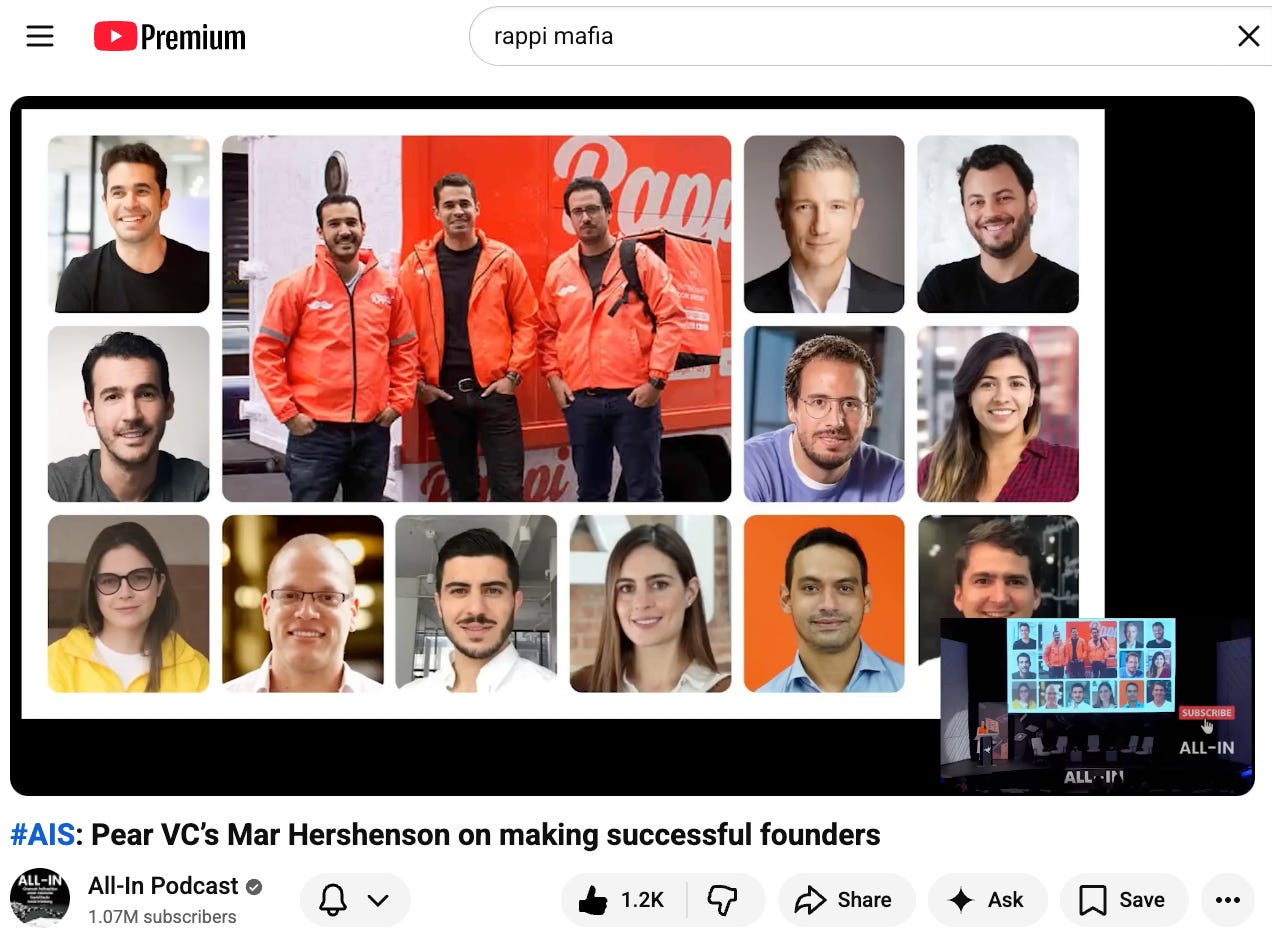
The current generation building Colombia’s tech ecosystem is 35- to 40-year-olds who were children during the Escobar years, when Medellín averaged 16 murders a day. The anchor unicorn is the delivery company Rappi (YC W16), currently valued at $5.25B.
Scaling a three-sided marketplace is hard, and the company almost closed several times. I’ve been deeply involved in Rappi from the early days, Simón used to say to me “you’re here to de-latinize Rappi, so we can really scale.” By which he meant imparting lean hyper-scaling operating teams and systems in each country.
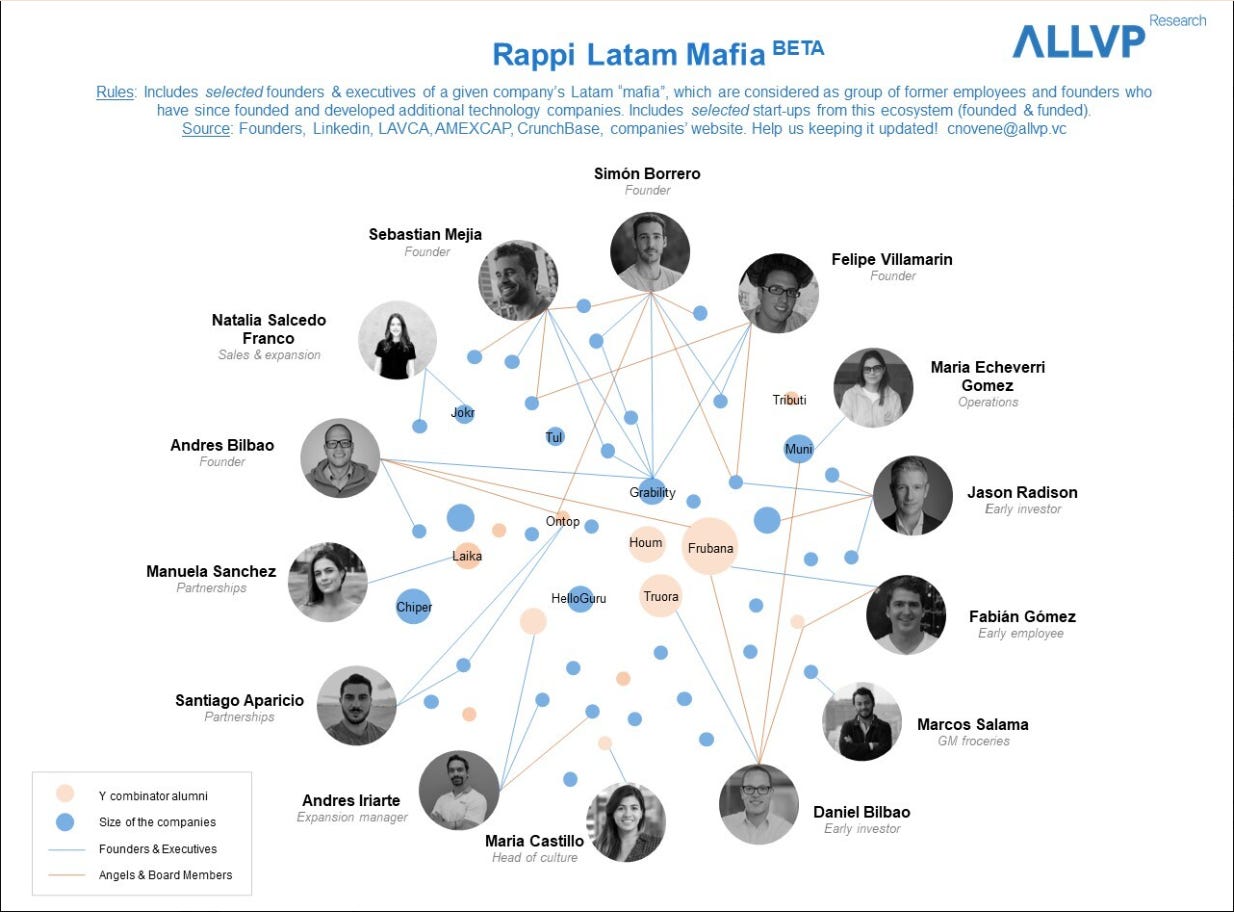
Rappi has since spawned more than 100 alumni-founded startups in under seven years, many venture-backed, roughly half funded by the original founders. Marathon Ventures data shows the Rappi mafia has created more companies in less time than any other Latin American unicorn.
If you want to get a firsthand sense of Colombia’s incredible founder talent density, listen to Robbie J. Frye’s The Frye Show, which has systematically interviewed more than 300 founders and investors in the Colombian ecosystem.
Salt Lake City and Denver-Boulder
In Denver-Boulder, Brad Feld, a military kid born on an Air Force base in Arkansas, moved to Boulder in 1995 knowing one person. He reinvested through Foundry Group ($3B+ AUM) and Techstars, and the ecosystem compounded. Dan Greenwood, a Denver investor, told the Colorado Sun in 2018 after Zayo's exit: "When we have a success story, like Zayo, and people leave the company as millionaires, what I've seen is the money cycles back into the ecosystem." That same cluster now has ~75 lieutenants who are founders in their own rights, and 200+ startups.
In Salt Lake City, a similar local reinvestment mechanism has been at work. Josh James, a military kid and college dropout, built Omniture from Utah County and sold it to Adobe for $1.8B. James reinvested locally, seeding 30+ companies and backing first-time SaaS founders across the Wasatch Front. When Adobe opened a campus in Lehi, the area was, as Wade Sherman told CNBC in 2024, “orchards and farmland.” Today there are over 1,000 companies in Utah’s “Silicon Slopes.”
In every row of the above table, it’s hard to overlook that breakout founders have very different life-experiences and early constraints than other white-collar professions.
The same two-stage mechanics are at work in U.S. second-tier metros that have reached escape velocity and are now first-tier tech markets in their own right.
Requirement 1: Sustained Founder Density.
Each city mentioned above followed the same trajectory. Outsider founders arrived, built, IPO-ed or sold their companies, and reinvested in local founders. With nurturing, a tree or two can become a dense forest in a generation.
In September 1957, eight engineers walked out of Shockley Semiconductor in Mountain View and founded Fairchild Semiconductor in Palo Alto. Fairchild’s outsider founders produced the original Silicon Valley cluster: 126 semiconductor companies by 1986. And more than 92 public Bay Area tech companies traced to Fairchild founders and employees by 2014, with combined market value above $2 trillion. One tree became a forest because the alumni stayed local, reinvested, and replicated their successes.
That same year, in Minneapolis, William Norris left Remington Rand’s UNIVAC division and founded Control Data Corporation with Seymour Cray and a team of ERA veterans. As often happens on the front end of a hot tech cycle, lieutenants who are most ready will strike out when the opportunity is most rife. Control Data’s spinoffs produced Cray Research, Ceridian, and begot Medtronic and Minnesota’s Medical Alley ecosystem.
The two early mainframe companies dominated their segments, and within a decade spawned dozens of spinoffs.
And for 30 years, the two ecosystems looked remarkably similar.
Then in the late 1980s and early 1990s Minnesota lost its computing cluster. CDC, UNIVAC, and Cray kept building mainframes and supercomputers while the world moved to PCs, software, and the internet. The founding generation retired, the capital dispersed, and nobody was left to restart Minnesota’s tech industry.
Medical Alley did survive and thrive. Medtronic, St. Jude Medical, 800+ companies, 95,000+ jobs. It kept compounding, precisely because its founders (Bakken, Villafaña) stayed local, kept founding companies and reinvesting locally.
Regardless, as the Chinese proverb goes: a sentinel tree, no matter how grand, is not the same as a forest.
Minnesota’s tech and medical clusters were disproportionately built by outsiders. Norris was an import from Nebraska; Cray, a self-described nerd from Wisconsin. Villafaña came to Minnesota from Puerto Rico via the Bronx. Parker from Massachusetts and Maine. Medtronic founder and pacemaker inventor, Earl Bakken, built an electroshock weapon to fend off bullies as a kid. I wrote about these founders individually in a previous piece on Minnesota’s missing civic power brokers.
Despite similar starts, while the medical industry reached escape velocity, Minnesota’s tech ecosystem never did.
The comfort trap: why markets like Minnesota under-index on founder talent
To much wringing of hands, Minnesota’s new entrepreneur rate is 0.17%, 50th nationally.
But that’s what happens when your economic identity is UnitedHealth Group, Target, 3M, and General Mills. Your best entrepreneurial talent emmigrates, and remaining top local talent takes corporate jobs.
The Fortune 500 base peaked at 22 in 1995, and it has leaked companies and career quality ever since (Norwest to SF, Honeywell to NJ, Northwest Airlines to Atlanta, St. Paul Companies to NYC).
While Minnesota, like many midwestern cities, focused on retaining headquarters, it missed the PC revolution, the internet revolution, the mobile revolution, and has so far been a spectator rather than an active participant in the AI wave as it breaks on us.
Requirement 2: Local Ecosystem Yield.
In the tech sector, it’s common knowledge that outcomes aren’t linear. Not just on a macro level, but also from the point of view of local cluster development. In addition to breakout founder density hitting critical mass, it also takes high quality exits to build an ecosystem.
An excellent exit means dozens and potentially hundreds of local people make millions (founders, lieutenants, angels, GPs, LPs). Whereas a ‘solid’ exit means one local person, maybe three (e.g., co-founders and the first angel check) do.
The difference is something I’m calling local ecosystem yield:
Local Ecosystem Yield = exit value × founder/angel/employee ownership (ie cap table quality) × local reinvestment rate.
Between excellent and solid is about two orders of magnitude difference in how many local breakout founders an exit produces. One lifts prosperity for generations and turns the market into a tech talent magnet, the other generates a few second homes.
PayPal’s $1.5 billion was an excellent outcome. Proceeds went disproportionately to founders and early employees who shared an operating playbook and continued wanting to work with each other. They stayed in the Bay Area and reinvested in each other’s projects. That one unicorn exit yielded 20 ecosystem builders.
The Rappi mafia, mapped below, shows the same reinvestment pattern in Latin America.
Minnesota’s exits are mostly ‘solid’ grade from a ecosystem yield perspective: i.e., much of the value accrued to dispersed public shareholders, PE owners, strategic acquirers, or founders no longer active in the local startup ecosystem.
From what I’ve been able to track down, our $30B in exits this century have generated just 4 breakout local founders:
Phil Soran (Compellent, $960M Dell acquisition) sits on the boards of Piper Sandler and SPS Commerce and is the most active ecosystem builder in the Twin Cities.
Chip Pearson (Jamf) runs When I Work and co-founded Bootstrappers.mn.
Ben Edwards (SmartThings) advises Great North Labs and helps run Minnebar.
Justin Kaufenberg (SportsEngine) runs Rally Ventures with over $1B in AUM and $100M+ deployed into 13 Minnesota companies.
Almost everyone else of note either retired from tech or has left the state.
The local growth stage funding gap
In a market like ours, when a successful local startup needs a $30M–$120M round, the lead check has to come from Sequoia, Andreessen Horowitz, Insight Partners, or another coastal growth investor. Those investors then sit on the board and pull founders and their companies toward their networks.
The board center of gravity shifts first. Then the executive network shifts. Then growth-stage hiring follows. We’ve seen the leakage pattern around the Twin Cities too: SmartThings had Minnesota talent in the founding mix and a Minneapolis developer center, but after Samsung the center of gravity moved to Palo Alto. Bright Health moved to Florida.
It’s a halting problem: until a market has sufficient founder talent density, the few VCs that do exist in markets like ours face LP preference for coastal deployment. Institutional allocators don’t trust a local market with a trickle of solid exits to compete with the returns their money could be making on the coasts.
The growth equity gap is at the same time a further symptom of the Ecosystem Yield problem. Low conversion of exits into local founder wealth, local operator liquidity, and local startup reinvestment, means less local venture capital to be deployed, along with fewer growth shops that can underwrite and write $30-50M lead check that keeps a team local.
Quantifying the gap
So if over-indexing on founder talent is the first step to getting the technology flywheel spinning, how much is enough?
The general rule of thumb, whatever your starting point: you need to import about 20 lieutenants of Tier 1 unicorn founders.
To be clear: you can’t fill this gap with retired Fortune 500 executives who join advisory boards and write $25K angel checks. The advisory class is not the founding class, and this level of founding team does not need such advisors.
Below is a comparison of four peers that started out this century as second or third tier technology markets.
Looking each metro’s stats above, the ones reached escape velocity had 2-3x the breakout founders and 5x the number of killer lieutenants.
Salt Lake City has a civilian labor force one-third the size of the Twin Cities and produces seven times the exits. The difference is breakout founder talent density and local ecosystem yield.
Where is your city on this curve and what can you do about it?
Every year, dozens of cities reach out to multi-exit founders like my friends and me. It’s always the same script. A boutique consultant hired by the city manager or economic development team, tells you on video call: “If you open an office and hire our employees here, we’ll give your company a tax benefit.” That’s it, that’s the pitch. This recruits caretakers, not breakout founders with something to prove.
Until your city gets both stages of this strategy right, every dollar spent on enabling conditions, rather than founder talent density, is a waste of time and taxpayer funds.
The winning playbook is both simple and hard at the same time:
Go recruit 20 breakout founders from companies like the ones in this article.
Give them a reason to move to your market over staying put. Sell your standard of living advantages hard, and make an explicit ask of them to come help you build your ecosystem.
Connect them with their first few local checks, customers and employees.
Figure out the $30M–$100M growth gap before the first cohort needs it to ensure their series B doesn’t pull their focus back to the coasts.
Measure what matters: how many founders stayed, how many started something new, how much capital recycled locally. Not second headquarter deals, or plant sitings.
The cities who already made it to first tier tech markets didn’t run a playbook, they just got lucky. If you want to catch them, you don’t have that luxury.
Founder talent density and exit wealth recycled through tight local networks are the foundation of every ecosystem in this dataset that reached escape velocity.
Now that you’ve read the research, and hopefully better understand the mechanism for getting to escape velocity, your city doesn’t have to rely on luck.
The question for your city: are you willing to do the playbook’s hard work to lift your city to Tier 1?
Or are you banking on your culture and Lake Wobegon talent odds to jump-start your ecosystem?
Bibliography
Primary Data
Fairlie, Robert W. “Indicators of Entrepreneurial Activity: 2023.” UCLA Luskin School of Public Affairs, June 2025. Link
Greater MSP Partnership. 2025 MSP Regional Indicators Dashboard. August 2025. Link
Startup Genome. Global Startup Ecosystem Report 2025. June 2025. Link
U.S. Bureau of Labor Statistics. Local Area Unemployment Statistics (LAUS). 2025. Link
U.S. Census Bureau. American Community Survey 2023 1-Year Estimates. Link
World Values Survey. Wave 7 (2017-2022): Colombia. Link
Books
Feld, Brad. Startup Communities: Building an Entrepreneurial Ecosystem in Your City. Hoboken, New Jersey: John Wiley & Sons, Inc., 2012.
Hall, Donald M. Generation of Wealth: The Rise of Control Data and How It Inspired an Era of Innovation and Investment in the Upper Midwest. Minneapolis: Nodin Press, 2015.
Price, Robert. Eye for Innovation: Recognizing the Possibilities and Managing the Creative Enterprise. New Haven: Yale University Press, 2007.
Soni, Jimmy. The Founders: The Story of PayPal and the Entrepreneurs Who Shaped Silicon Valley. New York: Simon & Schuster, 2022.
Veras, Paulo. Unicórnio Verde-Amarelo. São Paulo, 2023.
Wynwachhorst. “In the American Mold: The Founders of Fairchild and the Pioneer Ethos.” 2013.
News and Periodicals
Axios Twin Cities. “Which Minnesota Companies Could Be the Next to Join the Fortune 500.” December 1, 2025. Link
Bring Me The News. “Minnesota Still Has 17 Fortune 500 Companies.” June 3, 2025. Link
Chuang, Tamara. “Denver’s tech ecosystem is a work in progress.” Colorado Sun. October 22, 2018.
CNBC. “How Utah’s ‘Silicon Slopes’ tech sector is making a run at Silicon Valley.” December 10, 2024.
Endeavor. “Endeavor Untold: Letting Go.” Paulo Veras. July 2025. Link
Fortune. “The PayPal Mafia.” Jeffrey M. O’Brien. November 26, 2007.
Fortune. “The wildest, craziest, most death-defying (Mormon) mogul on the planet!” February 5, 2014.
Fortune. Fortune 500 List, 2025 Edition. June 2025. Link
Ha, Anthony. “The Fairchild Family Tree.” TechCrunch, November 2014.
Hoefler, Don C. “Silicon Valley USA.” Electronic News, January 1971. Updated genealogy maintained by SEMI.
NeoFeed. “Mafia da 99.” São Paulo.
Rest of World. “Rappi mafia: How a delivery startup took over Colombia’s tech scene.” July 2022. Link
Borrero, Simón and Hermanos Bilbao. “Colombia puede ganar el mundial.” Substack, May 10, 2026. Link
Twin Cities Business. “Dynamic Changes to Fortune 500s in Minnesota.” September 2018. Link
Twin Cities Business. “Fortune 500 List Contains Some Warnings for Minnesota.” June 2025. Link
Twin Cities Business. “Minnesota’s Fading Fortunes.” May 2017. Link
Corporate and SEC Filings
Abbott Laboratories. Form 8-K: Acquisition of St. Jude Medical. January 4, 2017.
Francisco Partners. Press Release: Acquisition of Jamf Holdings. October 2025; acquisition closed January 2026.
Piper Sandler Companies. Board of Directors. Link
SPS Commerce, Inc. Board of Directors. Link
Thanks for the data and context. Helpful.
A few reflections came to mind after reflecting on the above.
Most of "us" are just a few generations from the farm (flyover country). The lingering effects of that culture are substantial, often minimally understood and seldom calculated for when planning and building new things here.
It's not that there is no risk taken in MN, but it needs to be calculated and familiar risk for "us" to take it. We're comfortable with the risk of planting seeds, retail and healthcare et al.
A bigger issue might be the massive coming change to middle managers and our big orgs due to AI and it's forthcoming impact on "work." So many of "us" are now those Carlson School educated middle managers in the big fortune 500's driving from suburb to suburb doing work soon be done very effectively delivered with less cost via agents.
What does this argument look like framed less as "be a modern city like your peers" and more like "there is a coming tornado and life as you know it is soon to vanish?" Therefore, start and fund AI companies in MN.
In MN, fear (right or wrong) drives behavior and funds far more effectively in my experience than comparison and or a great vision of a better future we should bring to reality together.
Thanks for sharing the line of thinking here. I have enjoyed following and thinking along.
For those that haven't lived here long they wouldn't know this.
But the gravitational pull to Naples, FL, which has a massive critical mass of wealthy 50-80 year old Minnesotans, is crushingly strong.
It's a weird phenomenon that's been building for 20 years and now seems to be the unwritten playbook once a Minnesotan becomes a decamillionaire.
I'm not saying they are wrong or bad people for doing this.
But it's unbelievably corrosive to the startup community when a tech founder or CEO who has become liquid immediately bolts, leaving the MN tech community out of sight and out of mind.
It means they aren't spending face time in MN, the region that helped make them their millions.
They're not taking coffees with founders, not judging pitch competitions, not showing up for Techstars Demo Days, not being accessible to the next fintech founder that wants to tap into their wisdom and rolodex.
It's something that I don't see NYC and SFBA fighting as much as us.
I'm working on a fix for this, a way to make lemonade out of it. If anyone wants to help me, I invite them to hit me up on LinkedIn.
In the 10 years after the exit to eBay, 100% of the Mafia stuck around SFBA. Not a single one moved their primary basecamp away from SFBA until very recently.